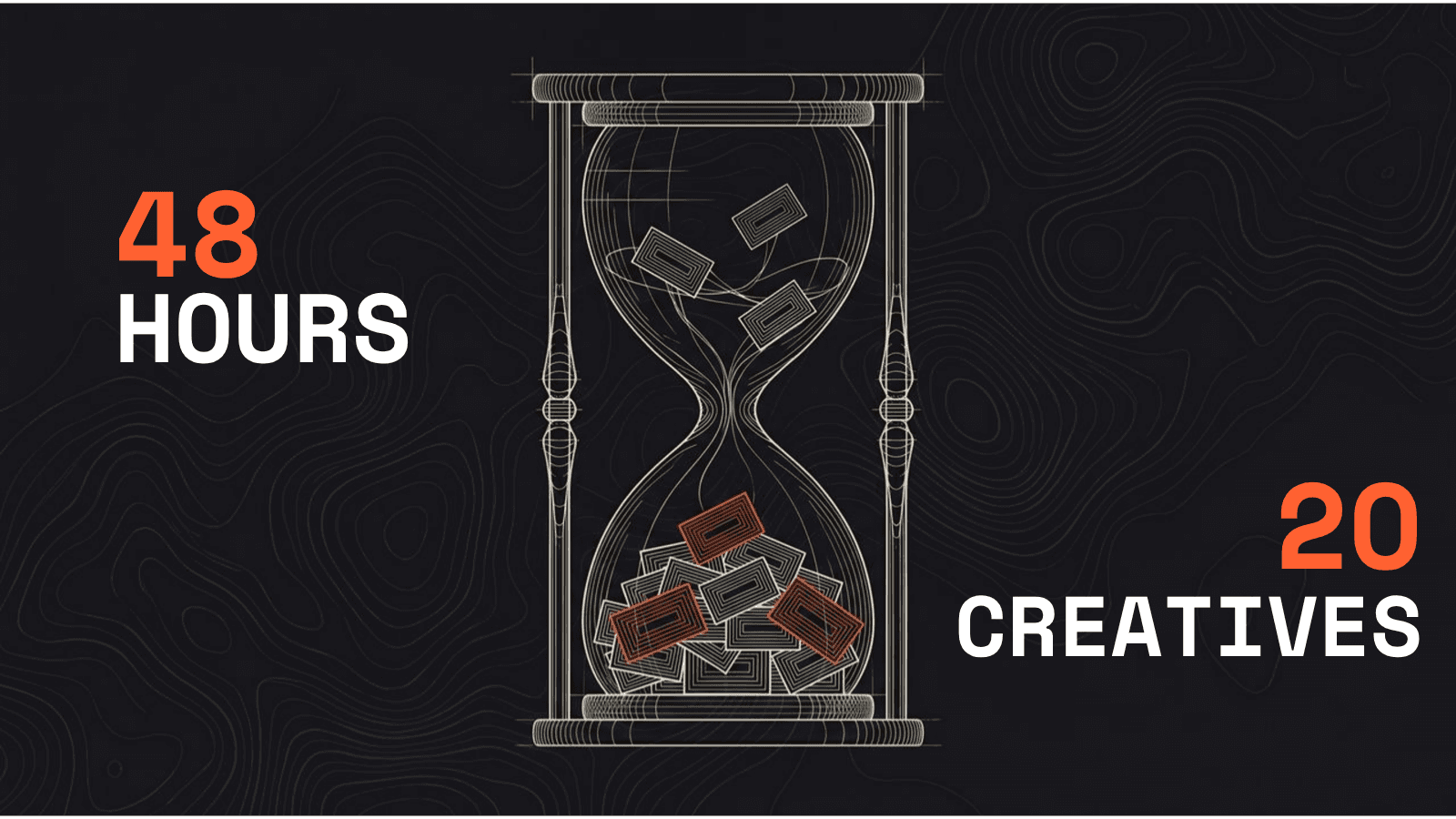
Shipping 20+ campaign-ready ad creatives in 48 hours requires an AI-native pipeline that combines multiple image generation models (Stable Diffusion, Flux, Midjourney), an LLM for batch prompt generation (Claude), and automated formatting workflows (n8n).
Running prompts through three models in parallel produces 5-10x the usable output of a single designer working sequentially. And automation removes the formatting bottleneck that kills most traditional creative processes.
The reason this matters: 62% of Indian D2C founders report creative fatigue as a constraint on their growth, where repeated creatives fail to sustain ROAS even with higher spend.
Industry benchmarks suggest brands spending over ₹2L a month on Meta need 15-30 new creative concepts per month to stay ahead of fatigue. Roughly one winning concept every working day, which almost nobody can produce with a traditional agency or freelancer workflow.
So the same five ads run for a month, frequency climbs past 4, ROAS tanks, and the founder spends Monday morning staring at the dashboard wondering if Meta is "broken." The platform isn't broken. The creative engine is.
At MARKTECH., we built the 48-hour pipeline because the alternatives weren't working. This post breaks down how it runs, what tools fit at each stage, and why volume is the lever almost everyone underestimates.
TL;DR
- →62% of Indian D2C founders report creative fatigue holding back ROAS even as spend rises
- →The benchmark for brands spending over ₹2L/month on Meta is 15-30 new creative concepts per month, with the higher end recommended at ₹10L+/month spend levels
- →Most agencies take a 2-week cycle to deliver what should be a 1-day output, because their pipeline isn't built for volume
- →A real AI creative pipeline combines image generation models (Stable Diffusion, Flux, Midjourney), LLMs for prompt batching (Claude), and automation (n8n) into a single workflow
- →The output isn't 20 random images. It's 20 variations built from a single brief, designed to test different hooks, angles, and visual treatments
How Many Ad Creatives Does a D2C Brand Actually Need?
Meta's algorithm needs fresh creative every 7-14 days. After that, your audience has seen the same ad 3+ times, your CTR drops, your CPM rises, and the algorithm starts pushing your ad to worse audiences because the engagement signal has weakened.
For a brand spending ₹5L per month on Meta, here's what the math actually demands. You need to test enough volume to find the 1-2 winners that drive most of your revenue, then refresh fast enough to stay ahead of fatigue.
The benchmark for brands at this spend level is 15-30 new creative concepts per month, weighted heavier on video as you scale.
Now look at what most brands actually produce. A traditional agency on a ₹3L monthly retainer typically delivers 8-12 creatives per cycle, with a 2-3 week turnaround per round. A freelancer might do 5-10 in a similar timeframe. An in-house designer juggling brand, social, packaging, and ads usually ships fewer than that.
The gap is brutal. The benchmark says 15-30, the actual output is 8-12, and the brand wonders why their ROAS keeps decaying. It's not the targeting. It's not the bidding. It's that creative output stopped being the input the algorithm needed.
Why Traditional Production Can't Close the Gap
The 2-week cycle isn't because designers are lazy. It's because every traditional creative pipeline has the same structure: brief → meeting → concepts → revisions → meeting → final → delivery. Every step has a human gate, every gate has a queue, and every queue takes days.
Here's what that timeline looks like when you actually count the calendar days:
| Day | Step |
|---|---|
| 1 | Brief sent to agency |
| 2-3 | Internal sync, account team forwards to creative team |
| 4-7 | Designer assigned, starts work, asks clarifying questions that were already answered in the brief |
| 8-12 | First round of concepts delivered, founder picks 2-3, sends feedback |
| 13-17 | Revisions, second round delivered |
| 18-21 | Final approval, exports, delivery |
Three weeks for 8 creatives. On a ₹3L monthly retainer, that math doesn't get you many shots at finding a winner. And by the time you ship them, your competitor running an AI-native pipeline has already tested 30 variations and knows which two are winning.
The problem isn't the people. It's that the pipeline was designed for a world where volume didn't matter. In 2026, with Meta's algorithm rewarding creative diversity and punishing fatigue, that pipeline is structurally incapable of keeping up.
What Does a 48-Hour AI Creative Pipeline Actually Look Like?
A real AI-native creative pipeline isn't one tool doing magic. It's multiple specialized tools chained together, with humans at the decision points where taste matters and AI at the execution points where speed matters.
Here's the actual flow:
Hour 0-4: The Brief and Reference Capture
The founder sends us one good photo of the product (phone camera is fine), one sentence about the campaign objective, and three competitor ads they wish they'd made. We use Claude to extract the patterns from those references: hook structures, visual hierarchies, color treatments, messaging angles.
The output is a brief that's specific enough for AI generation. Not a 30-page deck nobody will read.
Hour 4-12: Prompt Generation at Volume
This is where most founders miss the biggest unlock. Writing 20 individual prompts by hand is slow and produces 20 similar ideas.
Using Claude or Gemini to generate 50-100 prompt variations from a single creative brief, with explicit instructions to vary the hook, angle, color treatment, and product placement, gets you a much wider creative search space in minutes.
Hour 12-24: Image Generation Across Multiple Models
We don't use one image generator. We use three, because each model has different strengths.
Stable Diffusion (via ComfyUI with ControlNet and IP-Adapter) handles product-accurate generation where we need the exact bottle, packaging, or product shape preserved.
Flux gives us cleaner outputs with better text rendering for any creative that has to include a price or claim.
Midjourney generates the lifestyle and background concepts that we then composite the real product into.
Running prompts through all three in parallel produces 50-80 raw outputs in a few hours.
Hour 24-32: Composite and Cleanup
Raw AI outputs don't ship as ads. The product placement needs to be perfect, the lighting on the product has to match the scene, and the brand colors need to be consistent across every variation.
Our system handles the compositing through depth maps and reference matching. Photoroom handles batch background cleanup. The output is 30-40 polished images that look like they came from a single styled shoot.
Hour 32-44: Filter, Format, and Variant Multiplication
From the 30-40 polished images, we pick the 20+ that actually work. Then each one gets formatted for different placements: Meta feed (1:1 and 4:5), Stories and Reels (9:16), and any required marketplace formats.
n8n automates the resize and export step so 20 base creatives become 60-80 placement-ready files without anyone touching Photoshop.
Hour 44-48: Final Review and Ship
The founder gets the full output in a shared folder, picks any final tweaks, and the campaign-ready files go straight to Meta Ads Manager. Done. 48 hours from brief to publish.
Need 20+ campaign-ready creatives in 48 hours? That's exactly what we build at MARKTECH. Talk to us.
Traditional vs. AI-Native: The Honest Comparison
| Traditional Agency | AI-Native Pipeline | |
|---|---|---|
| Turnaround | 2-3 weeks per round | 48 hours per round |
| Creatives per cycle | 8-12 | 20-30 |
| Revisions | Built into the timeline (days each) | Real-time during the run |
| Effective cost per creative | High (driven by retainer + low volume) | Low (volume amortizes the system cost) |
| Brand consistency | High (one designer) | High (model fine-tuning + brand color enforcement) |
| Scaling cost | Linear (more designers = more cost) | Logarithmic (same pipeline, more variations) |
| Best for | Pitch decks, brand films, static catalog | Performance ad creative at volume |
What This Means for Your Brand
Three things, regardless of whether you ever work with us:
1. Count your current monthly creative output, then count your spend. If you're spending over ₹2L/month on Meta and producing fewer than 15 unique creatives a month, your bottleneck isn't budget or targeting. It's volume. Fix that first.
2. Stop briefing for one campaign at a time. If you're going to refresh creative every 2-3 weeks, you need a system that produces in batches, not a process that produces one round at a time. This is the structural shift most founders don't realize they need to make.
3. The right question isn't "should we use AI?" It's "do we have a system that can produce 20+ usable creatives in a tight enough window to keep ahead of fatigue?" The answer might be AI, might be a faster agency, might be an in-house team with the right tools. The volume target is the goal. Pick whatever pipeline gets you there.
For Drink ANOTHR, this approach delivered 20+ creatives in the first sprint, 3.41x best ROAS on Lemon Lime, and a ₹249 best CAC. The system is the moat, not any individual ad.