You're spending ₹5L/month on Meta and your ROAS is stuck at 1.8x. You've tried broad targeting, lookalikes, interest stacking, Advantage+ campaigns, and nothing moves. So you blame the ads.
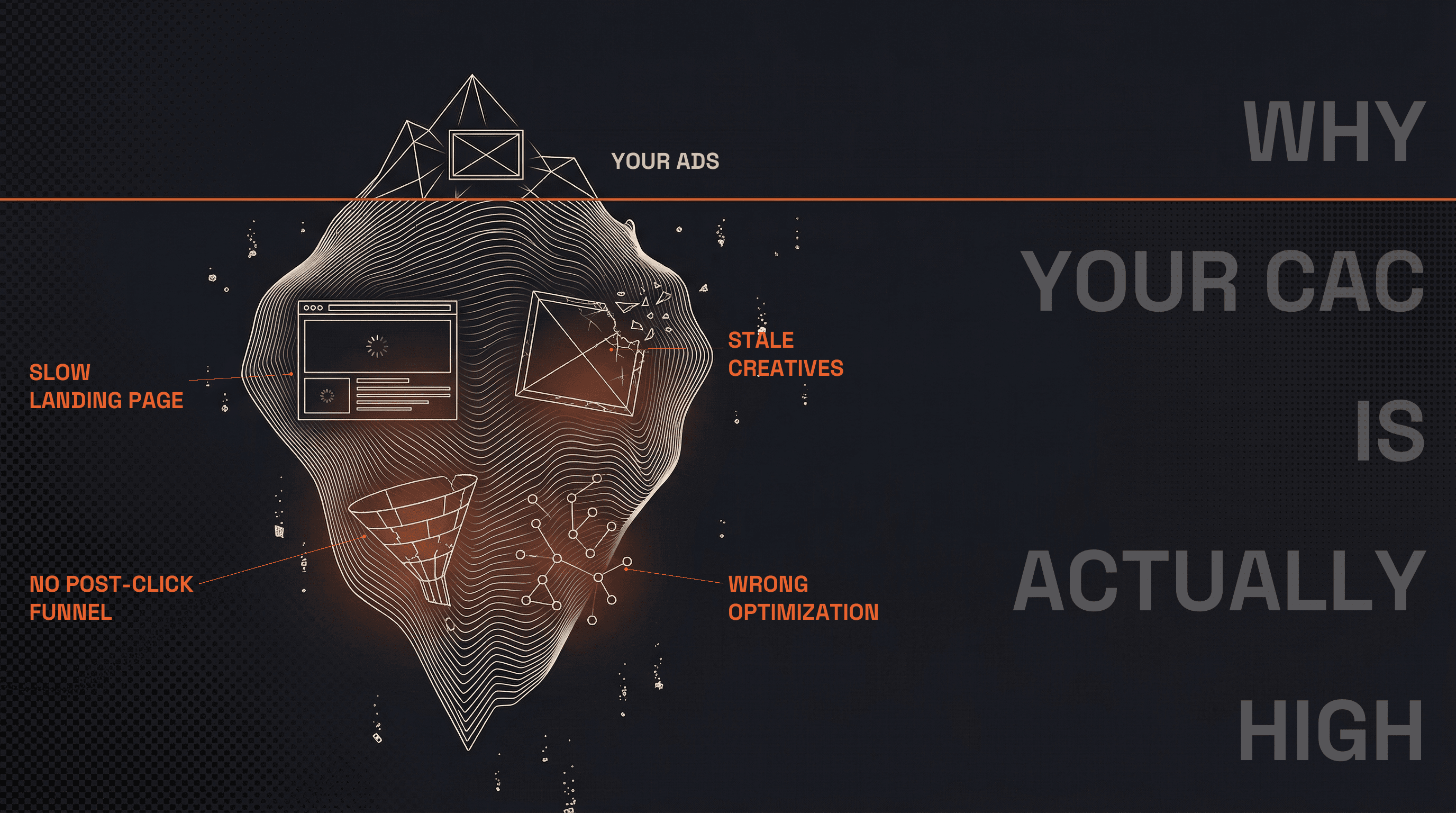
Here's the thing most people miss: your ads might actually be fine. Your CAC is high because of everything around the ads that nobody bothers to look at.
At MARKTECH., this is the pattern we keep coming back to. High CAC almost never traces back to targeting. It traces back to creative volume, landing page experience, and the post-click funnel. The stuff that isn't sexy enough for an agency to put on a slide.
TL;DR
- →The average Indian D2C brand's CAC rose 25-40% between 2022 and 2024
- →Creative quality accounts for 56% of a digital ad's sales impact, while targeting is only 12%
- →Running 11+ creatives per ad set can reduce CPA by up to 50%
- →Most high-CAC problems aren't about the ads themselves. They're about creative fatigue, weak landing pages, and missing post-click funnels
- →Fix the 5 things below before you touch your campaign structure
Your CAC Isn't High Because of Your Targeting
Every D2C founder's first instinct when CAC spikes is to fix the targeting. They test new audiences, tweak the lookalike percentages, add interest layers, exclude converters, and sometimes rebuild the whole campaign from scratch. And CAC stays the same, or gets worse.
Here's why that keeps happening. Research shows that creative quality drives 56% of a digital ad's sales lift. Targeting? Just 12%. Placement accounted for 8%, and reach covered the remaining 24%.
That means creative is 4.6x more important than targeting. The reason your CAC is high probably has nothing to do with who you're showing the ad to. It's what you're showing them.
The 5 Real Reasons Your CAC Is Too High
1. Creative Fatigue Is Silently Burning Your Budget
Your best-performing ad has a shelf life of about 2-3 weeks. After that, the same audience has seen it 3+ times, CTR drops 20-40%, CPM rises, and Meta's algorithm starts pushing it to worse audiences because the engagement signal has weakened. You end up paying more to reach worse people with stale creative.
Brands lose roughly 10-20% of their total ad budget to creative fatigue when they don't have a refresh system in place. Most don't even realize it's happening because the decline is gradual.
The fix isn't making one great ad. It's building a system that produces 15-20 good ones and rotates them constantly. Advertisers running 11+ creatives per ad set see up to 50% lower CPA than those running fewer than 5. That's not a slight improvement. That's half the cost.
Most Indian D2C brands run 3-5 creatives total, then wonder why CAC keeps climbing every month.
2. Your Landing Page Is Bleeding Conversions
You could have the best ad in the world, but if the landing page takes 6 seconds to load on a Jio connection in Lucknow, you've already lost the click you paid for.
High bounce rates signal to Meta that your clicks aren't converting, and the algorithm responds by raising your costs. It becomes a death spiral. Bad page speed leads to fewer conversions, which leads to higher CPMs, which leads to even worse CAC.
Here's what's common across Indian D2C landing pages:
- →Heavy Shopify themes loaded with 4MB hero images that nobody optimized
- →No real mobile optimization despite 70%+ of Indian traffic coming from phones
- →Product page copy that says nothing about why someone should buy this over 30 alternatives
- →Missing trust signals above the fold. No reviews, no shipping info, no return policy
- →Five-step checkout processes when two steps would do
A 1-second improvement in page load time can increase conversions by 7%. That's not a marginal gain when you're spending lakhs on traffic.
3. You're Optimizing for the Wrong Event
This one is painfully common with early-stage D2C brands. They optimize for link clicks because clicks are cheap, or add-to-carts because it "fills the funnel." Then they're confused about why none of those cheap clicks convert into actual purchases.
Here's how the math actually works:
| Optimization Event | Avg. Cost per Event | Conversion to Purchase |
|---|---|---|
| Link clicks | ₹3-8 | 0.5-1.5% |
| Add to cart | ₹30-80 | 8-15% |
| Purchase | ₹150-400 | 100% (by definition) |
Optimizing for link clicks at ₹5 each looks cheap on the dashboard. But if only 1% of those clicks convert to a purchase, your effective CAC is ₹500. Optimizing directly for purchase at ₹300 gives you a ₹300 CAC. The "cheap" option ends up being 67% more expensive.
If you're spending over ₹2L/month, optimize for purchase events always. If your pixel doesn't have enough purchase data yet (under 50 conversions/week), use add-to-cart as a stepping stone, but never settle for click optimization.
Spending ₹2L+ on Meta and your CAC won't come down? We build AI creative systems that ship 20+ creatives in a single sprint. Talk to us.
4. You Have No Post-Click Funnel
Most D2C brands treat every customer like a one-time transaction. Someone visits the site, doesn't buy, and they're just gone forever. You paid for that click and it converted into absolutely nothing.
A post-click funnel captures value from every visitor, not just the 2% who buy on the first visit:
- →Email/SMS capture popup ("Get 10% off your first order") captures 3-8% of visitors who would otherwise leave and never come back
- →Retargeting that shows them the exact product they viewed. This should be your cheapest CAC channel by far
- →Abandoned cart recovery via WhatsApp or email within 1 hour, which recovers 10-15% of abandoned carts in India
- →Post-purchase upsell ("Add X for ₹199" on the thank-you page) increases AOV, which effectively reduces your CAC
Without this system, you're paying full acquisition cost on every single order. With it, your blended CAC drops 30-50% because returning customers and recovered carts cost almost nothing to convert.
5. Your Creative Isn't Actually Saying Anything
This is different from creative fatigue. Fatigue means your creative was good but got stale. This problem is about creative that was never particularly compelling to begin with.
Signs your creative isn't cutting through:
- →CTR below 1% on feed placements
- →Thumb-stop rate below 25% on video
- →High impressions but low clicks, meaning people see it and just scroll past
- →Outbound clicks that don't match landing page sessions, meaning people click but bounce before the page even loads
Your ad needs to answer one question in the first 3 seconds: "Why should I stop scrolling?" That's not a branding question. It's a survival question. Your ad competes with 300+ pieces of content per day in your customer's feed, and a pretty logo with a lifestyle shot won't cut it.
What actually works: a specific claim ("₹399 for 30 days of protein"), a visual disruption (unexpected color or layout break), or a direct comparison ("Your protein bar has 12g sugar. Ours has zero.").
The Real CAC Math Nobody Shows You
Here's what a healthy D2C CAC structure looks like at ₹5L/month in Meta spend:
| Channel | % of Orders | CAC | Blended Impact |
|---|---|---|---|
| Paid (first touch) | 40% | ₹800-1,200 | Primary driver |
| Retargeting | 25% | ₹150-300 | Cheapest paid channel |
| Organic/SEO | 15% | ₹0 (content cost only) | Long-term play |
| Email/WhatsApp | 15% | ₹20-50 | Retention gold |
| Referral | 5% | ₹100-200 | Trust-based |
Blended CAC: ₹400-600
Most D2C brands only look at the first row. They see ₹1,000 CAC on paid, panic, and start tearing apart their campaigns. But if you build the other four channels, your blended CAC drops to roughly half of what paid-only shows you.
The brands with "great CAC" don't necessarily have cheaper ads. They have better systems built around the ads.
What to Do This Week
1. Audit your creative volume. Open your Meta account and count how many unique creatives are actually active right now. If it's under 10, that's your first problem. You should have 15-20 active at any given time.
2. Check your landing page speed. Run your main product page through Google PageSpeed Insights. If the mobile score is below 60, fix that before spending another rupee on ads.
3. Switch your optimization event. If you're optimizing for anything other than purchases and you have 50+ conversions per week, change it today.
4. Set up abandoned cart recovery. If you don't have a WhatsApp or email sequence for abandoned carts, you're leaving 10-15% of revenue on the table. Tools like Wigzo, WebEngage, or even basic Shopify flows will get you started.
5. Build a creative refresh system. The real advantage isn't one great ad. It's a system that produces 15-20 new creatives every month without burning out your team. That's exactly what we built at MARKTECH. for Drink ANOTHR: 20+ creatives shipped in the first sprint, 3.41x best ROAS, ₹249 best CAC. Read the full case study.